en
 English
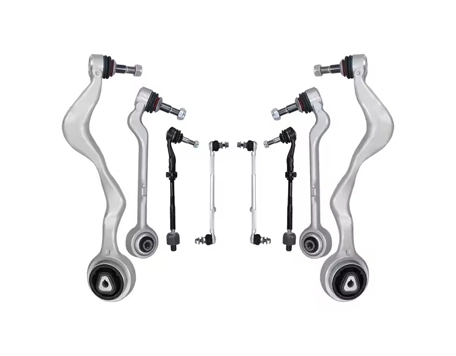
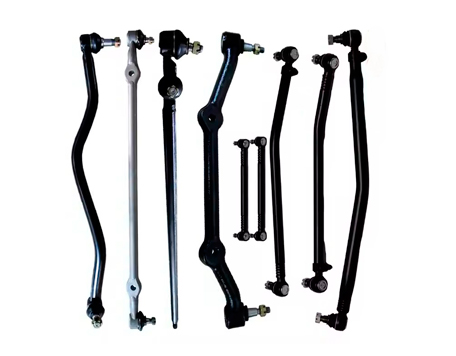
Control arms and ball joints are essential components of a vehicle's suspension and steering systems, working together to ensure smooth, stable, and safe driving.
A control arm, commonly known as an A-arm or wishbone, serves as a key suspension link that attaches the wheel hub to the vehicle's frame. This connection permits the wheels to travel vertically in response to road conditions while preserving accurate alignment. Control arms guide wheel motion during steering inputs and over uneven surfaces, offering a pivotal attachment that enables the suspension to effectively cushion impacts from the road. Typically, systems feature upper and lower control arms, with upper ones often appearing in front suspensions and lower ones in both front and rear setups. Their primary role involves securing the wheel hub, allowing vertical movement as the suspension cycles through compression and rebound, thereby upholding critical alignment angles like camber, caster, and toe for optimal stability, handling, and control.
A ball joint functions as a spherical bearing that links the control arm to the steering knuckle, facilitating fluid movement in multiple directions. This design supports wheel turning for steering as well as vertical travel with the suspension. Ball joints come in load-carrying varieties, which bear the vehicle's weight, and non-load-carrying types focused mainly on steering geometry. They provide a versatile junction that accommodates suspension articulation while permitting precise wheel pivoting for directional changes. Additionally, they help mitigate shocks from road imperfections like bumps and potholes, enhancing overall ride comfort and vehicle response. Well-maintained ball joints are vital for safety, since any failure risks compromising driver control.
Control arms and ball joints create an integral connection bridging the suspension and steering mechanisms. The control arm delivers structural steadiness and alignment integrity, complemented by the ball joint's provision of essential articulation for both steering maneuvers and suspension travel. This synergy results in refined ride characteristics, accurate steering feedback, and efficient impact damping. By keeping tires firmly planted on the pavement, they promote superior traction, braking efficiency, and comprehensive vehicle command.
Identifying issues with control arms and ball joints promptly is crucial for preserving vehicle safety and drivability. Common indicators include visible deterioration such as cracks, heavy corrosion, or degraded bushings, which can be spotted during a thorough visual check along with any abnormal looseness when manually manipulating the parts. Drivers may hear clunking or squeaking sounds over bumps or while cornering, experience vague or delayed steering response, or notice the vehicle wandering. Uneven or accelerated tire tread wear often stems from misalignment triggered by these faults, while altered handling—like pulling to one side or increased body sway in curves—can also point to problems. For hands-on assessment, safely elevate the vehicle and perform a wiggle test on the wheel in vertical and horizontal directions to reveal excessive play. Alternatively, apply gentle leverage with a pry bar to the components while supported, checking for movement exceeding acceptable limits.
Over extended use, control arms and ball joints naturally degrade from ongoing motion and contact with road contaminants, leading to noises, irregular tire wear, steering instability, and vibrations. Corrosion or physical impacts can further compromise their strength and reliability. To counteract this, incorporate regular examinations during standard services like tire rotations or wheel alignments to catch wear, rust, or damage early. Keep lubricable ball joints adequately greased to minimize friction and extend service life. When replacement becomes necessary, opt for prompt installation of superior parts that align with or surpass original equipment standards for assured safety and functionality.
Grasping the functions of control arms and ball joints is fundamental to sustaining peak condition in your vehicle's suspension and steering setups. These interrelated parts collaborate to deliver a secure, fluid, and enjoyable drive through consistent wheel positioning and road shock mitigation. Ongoing checks and proactive replacements play a key role in upholding safety and performance. For reliable and high-quality suspension parts, trust Dpatking to meet your automotive needs. If you require assistance or premium parts, contact us to explore how Dpatking can support your vehicle's performance and safety.
This is the last one.