en
 English
Having a basic understanding of the suspension components in your vehicle allows you to identify when they need replacement and address issues promptly, avoiding more significant problems down the road. Your vehicle contains numerous suspension parts that work together, and as an owner, gaining a general knowledge of these components helps ensure timely maintenance while minimizing risks. This awareness also equips you to handle various long-term challenges related to your car's suspension.
The primary role of a car's suspension system is to deliver a safe and comfortable ride for both passengers and the driver by reducing the impact of road irregularities and vehicle vibrations. It ensures safe and predictable handling, assists with effective braking, and prevents excessive body sway during acceleration, deceleration, or cornering. Additionally, the system helps minimize tire wear, maintains strong traction and grip by keeping the wheels in proper contact with the road surface, and overall contributes to a smoother driving experience.
The most essential automotive suspension components collaborate to help you navigate road obstacles effectively while preserving a comfortable and stable ride.
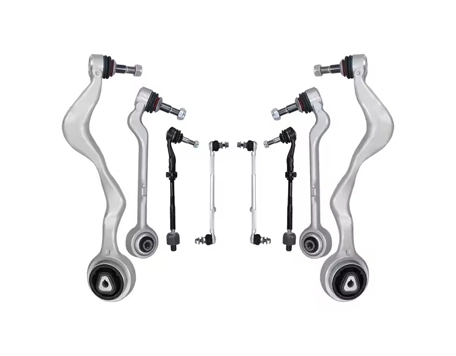
The control arm, sometimes referred to as the A-arm due to its triangular shape that resembles the letter "A," is one of the most noticeable parts in a vehicle's suspension. One end connects to the spindle via a ball joint, while the opposite end attaches to the frame through a bushing, allowing controlled movement of the wheels.
Bushings are small yet crucial rubber components that should not be overlooked when learning about suspension parts. Typically made from synthetic rubber surrounding two metal sleeves, they enable smooth coordination between connected elements. These bushings allow suspension components to move freely, even over large potholes, without causing major issues. Polyurethane bushings are also available and offer greater durability compared to standard rubber options.
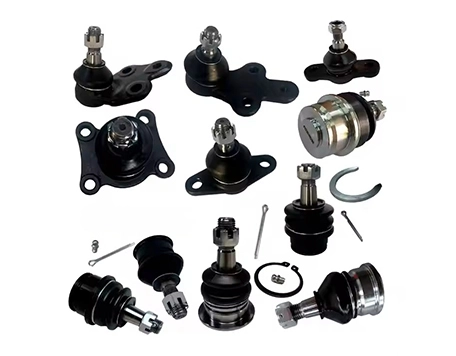
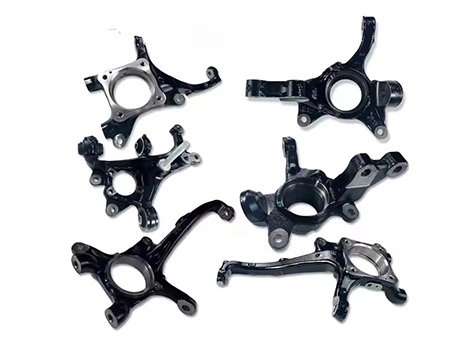
Ball joints resemble spherical bearings and serve to connect the steering knuckles to the control arms. They play a vital role in linking the suspension and steering systems, ensuring safe vehicle operation. Unlike typical industrial ball joints, those used in vehicles come pre-lubricated and do not require sealed designs.
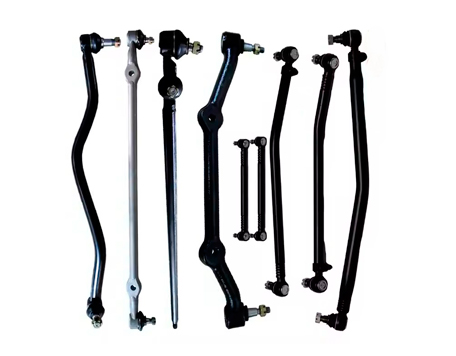
The stabilizer bar, also called the sway bar, connects to the suspension system and primarily works to reduce body roll and jerking caused by uneven road surfaces, while helping maintain road grip. The stabilizer link is a connecting rod that joins both ends of the stabilizer bar to the suspension, holding the bar securely in place during driving.
The trailing arm is a rear suspension component found toward the back of the vehicle. In certain designs, it connects the wheel assembly to the chassis through bushings or ball joints, allowing vertical wheel movement while preserving alignment. This part helps maintain rear wheel positioning, enhances vehicle stability, and absorbs road impacts and vibrations.
Shock absorbers are key elements in the suspension system, responsible for controlling spring oscillations and preserving overall vehicle stability. They dampen vibrations and shocks encountered on the road, keeping the tires in consistent contact with the surface and preventing excessive bouncing. Various types exist, including gas-filled, hydraulic, and others, and maintaining them in good condition is essential for long-term vehicle performance and durability.
A car's suspension system is a vital aspect of the overall driving experience, providing safety, comfort, and control. Every component performs a specific role that collectively enhances vehicle performance. Keeping this knowledge in mind will prove valuable for any car owner.